
Tarrant County Water Well Regulations & Permit Requirements, TX
Quick Answer
Tarrant County is regulated by the Northern Trinity Groundwater Conservation District (NTGCD), which requires a permit for most new non-exempt wells.
Quick Answer
Tarrant County is regulated by the Northern Trinity Groundwater Conservation District (NTGCD), which requires a permit for most new non-exempt wells. Domestic and livestock wells, and other wells that cannot produce more than 17.36 gallons per minute, are exempt from permitting under NTGCD Rule 2.1. Trinity Aquifer wells — Paluxy and Twin Mountains, separated by the Glen Rose confining unit — supply most private wells in the county.
Which GCD Governs Tarrant County?
Water well drilling in Tarrant County is regulated by the Northern Trinity Groundwater Conservation District (NTGCD), a single-county district that covers only Tarrant County. NTGCD was created in 2007 by the 80th Texas Legislature (HB 4028) and is codified as Chapter 8820 of the Texas Special District Local Laws Code. Its rules and current forms are published at ntgcd.com.
A quick but important note: the Northern Trinity GCD is a different district from the North Texas GCD, which covers Collin, Cooke, and Denton Counties to the north and east. The names are similar and both districts use a comparable rule structure, but they are separate legal entities. For a Tarrant County property, the district is Northern Trinity GCD.
NTGCD’s role is in addition to the state-level licensing administered by the Texas Department of Licensing and Regulation (TDLR). Your well must be drilled by a TDLR-licensed driller regardless of the district, and the driller files the required state well report after completion. Property owners should keep a copy of that report and any NTGCD permit or registration for their records.
Exempt vs. Non-Exempt Wells in Tarrant County
This is where the most common misconception comes up. Texas Water Code includes a statewide 25,000-gallon-per-day default, but that is not the rule Northern Trinity GCD operates under. NTGCD’s exemption is set by Rule 2.1 and is based on use category and pumping capacity, not a daily gallon figure.
Under NTGCD Rule 2.1, the following are exempt from water-use fees, metering, reporting, and permitting:
- Wells used solely for domestic, livestock, poultry, or agricultural irrigation use.
- Non-public-water-supply wells that, as equipped, cannot produce more than 17.36 gallons per minute and are used at least partly for a purpose other than solely domestic, livestock, poultry, or agricultural irrigation.
- Leachate wells and monitoring wells, subject to specific reporting and metering conditions to verify the exemption.
- Closed-loop geothermal wells, which must give notice to registered well owners within 200 feet and are exempt from Rule 4.2 spacing requirements.
- Temporary wells supplying water for a rig actively drilling a district-permitted production well.
If a well claimed as exempt under the 17.36 gpm provision is later found to have capacity above 17.36 gpm, NTGCD may make it subject to fees, metering, reporting, and other requirements. Most single-family domestic wells fall comfortably within the exempt category.
Non-exempt wells — irrigation, commercial, or higher-volume production — are subject to NTGCD operating permits, may carry production limits, and require semi-annual reporting. NTGCD also requires a hydrogeologic report for applications requesting 50 million gallons or more per year, for groundwater transported outside the district, and for certain groups of two or more wells within a quarter-mile whose combined requested production reaches that threshold.
Permit & Registration Process
For a non-exempt well, the general sequence is:
| Step | What happens |
|---|---|
| 1 | Contact Northern Trinity GCD (ntgcd.com) for the current application and fee schedule |
| 2 | Submit the application and applicable fee to NTGCD |
| 3 | Receive NTGCD approval before drilling begins |
| 4 | Use a TDLR-licensed driller; drill and complete the well to TDLR and NTGCD standards |
| 5 | The driller files the required state well report; submit any NTGCD well report within the rule deadline to avoid forfeiting the well-report deposit |
Exempt domestic and livestock wells still must be drilled by a TDLR-licensed contractor and meet state construction standards, and NTGCD registration/reporting conditions can still apply. Contact NTGCD to confirm what your specific use requires.
Fees are set by NTGCD and updated periodically by the Board, so confirm current amounts on NTGCD’s fee schedule at ntgcd.com rather than relying on a figure quoted elsewhere.
Tarrant County Geology & Typical Well Depths
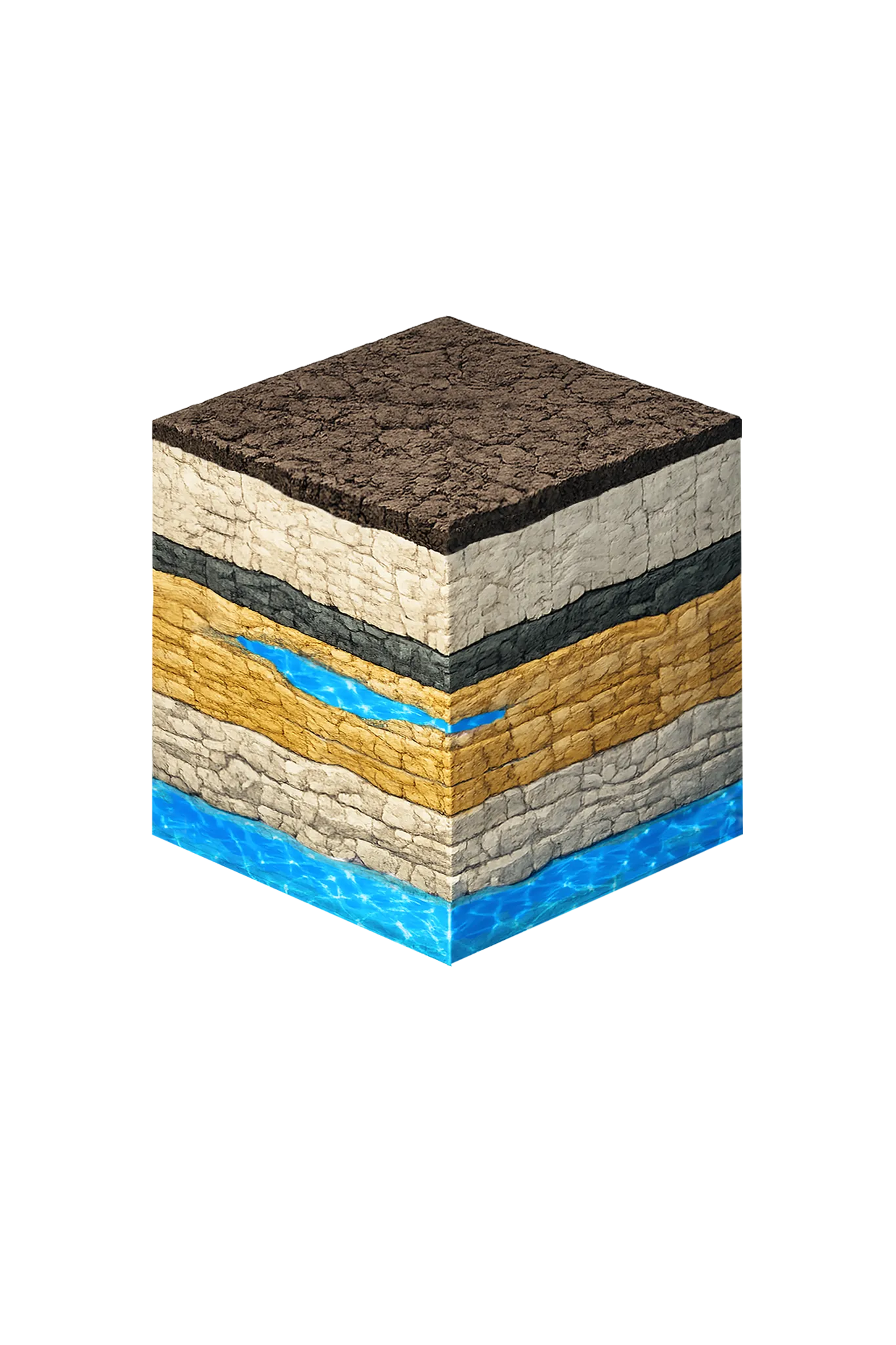
Tarrant County sits over the Trinity Aquifer, a Lower Cretaceous groundwater system. In NTGCD’s framework the Trinity here is made up of the Paluxy (upper sand unit), the Glen Rose (which functions mainly as a confining unit), and the Twin Mountains (the lower sand unit, which includes the Hensell, Pearsall, and Hosston subdivisions). Most domestic wells target the Paluxy or the Twin Mountains, with the Glen Rose separating the two.
Aquifer depth increases from west to east across the county, following the regional dip. The Paluxy ranges from the surface to roughly 1,000 feet, and the Twin Mountains roughly 500 to 2,000 feet. Trinity outcrop in Tarrant County is limited to the far northwestern corner; most of the county is in a confined, downdip setting, so wells reach the producing sands at depth rather than near the surface.
| Formation | Role | Notes |
|---|---|---|
| Paluxy | Upper Trinity sand | Sand, silt, and clay with fine sand dominant; sandstones make up more than 60% of the unit across most of the district; surface to ~1,000 ft |
| Glen Rose | Middle Trinity | Functions primarily as a confining unit between Paluxy and Twin Mountains |
| Twin Mountains | Lower Trinity sand | Medium- to coarse-grained sand, silty clay, and conglomerate; includes Hensell/Pearsall/Hosston; ~500–2,000 ft |
| Woodbine | Minor aquifer (eastern Tarrant County) | Sandstone interbedded with shale; lower yields and poorer quality than Trinity; higher iron, TDS over 1,500 mg/L measured |
The Woodbine is a secondary, minor aquifer found primarily in eastern Tarrant County. It supplies some domestic and livestock use but yields less and is generally poorer in quality than the Trinity, with elevated iron and total dissolved solids reported above 1,500 mg/L. A narrow band of Quaternary alluvium along the Trinity River is a minor shallow source where present, but it is not a reliable countywide target.
Most Tarrant County residents are on municipal surface water from Fort Worth, Arlington, and other utilities, so private wells are concentrated in larger-lot, fringe, and semi-rural areas. Because depth and yield depend heavily on location and which Trinity interval is targeted, site-specific depth is best determined by a licensed driller using nearby well records.
Water Quality
NTGCD reports that northern Trinity Aquifer water is generally fresh, with total dissolved solids typically below 1,000 mg/L, and predominantly sodium-bicarbonate in character. Woodbine water is more variable, with measured concentrations above 1,500 mg/L TDS and elevated iron, especially in the upper zones. Common things to test for include coliform bacteria, nitrate, hardness, iron, manganese, total dissolved solids, sulfate, and fluoride, with arsenic where local records suggest it. We recommend a full water quality test after any new well is completed.
Setbacks
NTGCD applies well spacing and location requirements under Rule 4.2 for new wells (wells lawfully drilled before December 17, 2018 are generally exempt from district spacing rules). Confirm current spacing distances directly with NTGCD, since the district’s rule controls. As a state baseline, TDLR guidance places a well at least 50 feet from property lines under minimum construction requirements (or as close as 5 feet with additional annular-space and cementing requirements), at least 50 feet from a septic tank, and at least 100 feet from septic drain fields or spray areas. NTGCD local rules may add to these.
Why Local Expertise Matters
Tarrant County combines urban density, Northern Trinity GCD oversight, and a confined Trinity Aquifer that deepens from west to east. Permit and registration handling, setback evaluation, and proper casing through the Trinity’s alternating sand and limestone intervals all call for regional experience. DFW Well Service (TDLR License #61234 DKMPW) knows the Northern Trinity GCD process and Trinity conditions across Tarrant County. We assist with permit and registration paperwork, handle required well reporting, and coordinate pump installation and water quality testing. Call (940) 536-8560 to discuss your property and get a site-specific estimate.