
Navarro County Water Well Regulations & Permit Requirements, TX
Quick Answer
Navarro County has no GCD. No local permit required to drill, but a TDLR-licensed driller and state standards apply. Main local aquifer is the Nacatoch Sand.
Which GCD Governs Navarro County?
None. Navarro County has no Groundwater Conservation District, so there is no local district to issue permits, set well-spacing rules, cap pumping, or require production reporting.
Wells in Navarro County are regulated only by TDLR (driller and pump-installer licensure under Texas Occupations Code Chapters 1901 and 1902, and 16 Texas Administrative Code Chapter 76) and the default rules of Texas Water Code Chapter 36. No local permit, spacing rule, fee, or production-reporting requirement applies. TCEQ’s March 2026 statewide GCD map confirms Navarro County remains outside any GCD. (For planning purposes, the southeastern Carrizo-Wilcox portion of the county falls within Groundwater Management Area 12, but a GMA is a planning framework, not a local permitting authority — it does not change anything for a property owner drilling a well.)
What that means for you as a property owner
A Navarro County property owner has no local district to impose well spacing, pumping limits, or drought curtailment, and has no local-district avenue to challenge a neighbor’s pumping. Texas common law applies, including the rule of capture. State well-construction standards still apply.
In plain terms: the absence of a GCD is not a loophole that makes drilling easier — it means there is no local referee if a neighbor’s pumping draws down your well. That’s worth understanding before relying on a well as your only water source.
Step-by-Step: Drilling a Well in Navarro County
| Step | Action | Who Is Responsible |
|---|---|---|
| 1 | Hire a TDLR-licensed water well driller and review nearby well logs first | Property owner |
| 2 | Check Texas Railroad Commission records for nearby abandoned or plugged oil/gas wellbores | Licensed driller |
| 3 | Confirm well siting and construction meet TDLR standards (16 TAC Chapter 76) | Licensed driller |
| 4 | Drill the well — no local permit or pre-drilling approval is required in Navarro County | Licensed driller |
| 5 | File the State of Texas Well Report with TDLR within 60 days of completion | Licensed driller |
| 6 | Test water quality before relying on the well | Property owner |
There is no local permit step because there is no GCD. The state well report is still required statewide and is filed by your driller.
Navarro County Geology & Typical Well Depths
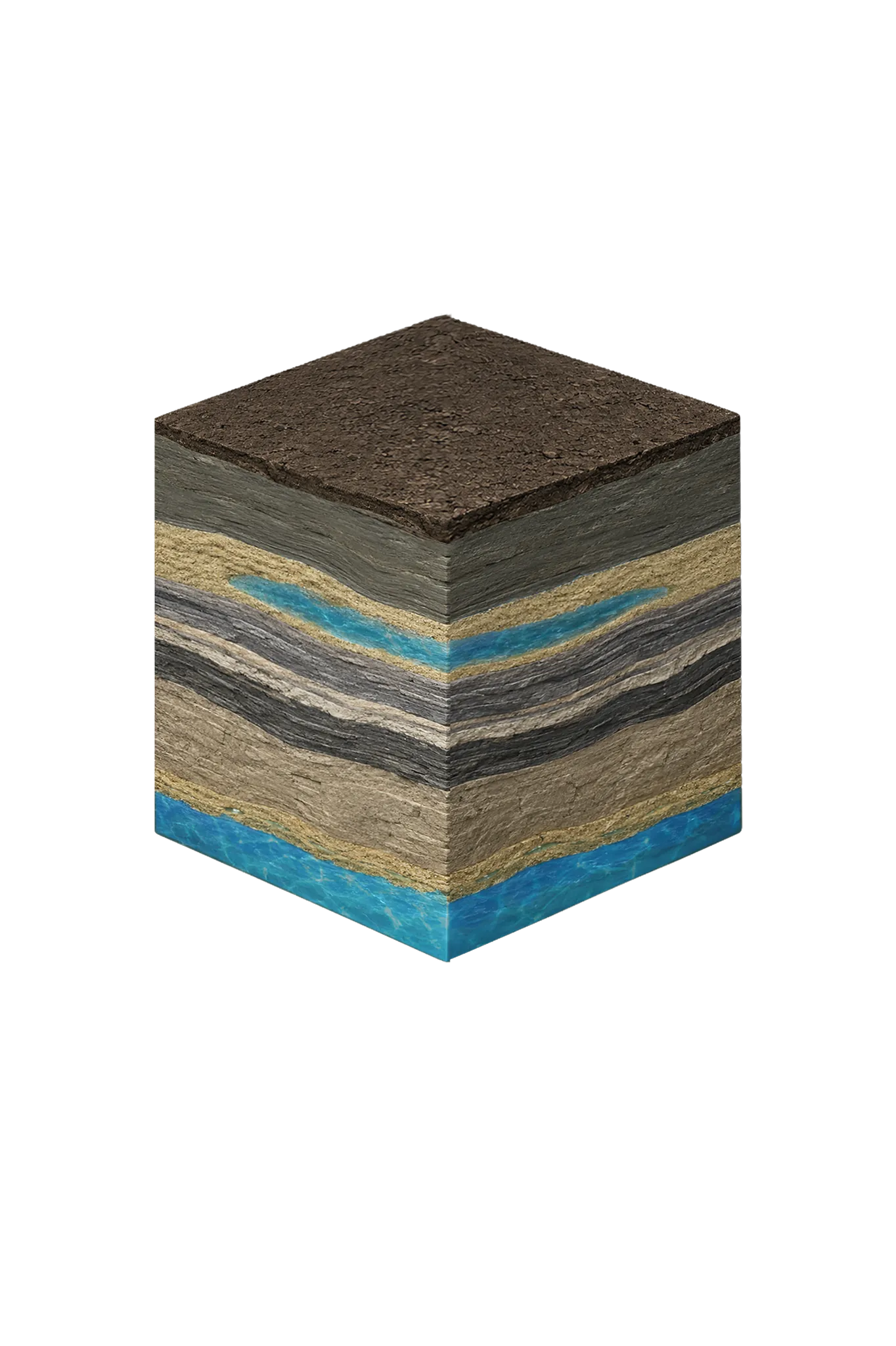
Navarro County sits on the Blackland Prairie at the southern end of the Nacatoch outcrop belt. There’s a notable piece of geological history here: Corsicana is the type locality for the Navarro Group, and the Corsicana Marl type locality is about two miles south of the courthouse at the Corsicana Brick Company pit. The principal local aquifer is the Nacatoch Sand, which outcrops across central and eastern Navarro County and dips to the southeast.
| Formation | Depth in Navarro County | Role |
|---|---|---|
| Quaternary alluvium / terrace | Shallow, along Trinity River corridor | Can yield up to 150 gpm locally where sand bodies are saturated; site-specific |
| Navarro Group clays and marls (Kemp Clay, Corsicana Marl) | Above the Nacatoch | Clay and marl; not aquifers |
| Nacatoch Sand | Roughly 100–800 ft (deeper to the southeast) | Principal local aquifer; yields commonly 10–15 gpm |
| Taylor Group, Austin Chalk, Eagle Ford, Woodbine | Below / deep | Not dependable modern residential targets in Navarro County |
| Trinity Group | Very deep and brackish | Not a residential target |
| Carrizo-Wilcox (Carrizo Formation, Wilcox Group) | Roughly 200–600 ft, far southeastern county only | Better-quality alternative — but only in the very southeastern corner |
The Nacatoch depth range is wide because the formation dips to the southeast at roughly 40 to 100 feet per mile, so a well near the outcrop is much shallower than one farther southeast. Treat the 100–800 ft band as planning context, not a guarantee. Corsicana itself sits on the Navarro Group outcrop, where residential wells typically target the Nacatoch at shallower depths (roughly 150–300 ft) but with low yields. Despite sitting on the aquifer’s namesake group, Corsicana is not a Trinity area and not a Carrizo-Wilcox area — both of those are absent beneath the city.
There is one genuine exception worth knowing. The Carrizo-Wilcox, a major aquifer, enters Navarro County only in the very southeastern corner, near the Freestone and Henderson county lines. In that small area its outcrop water is generally better quality than the Nacatoch. Everywhere else in the county, the Nacatoch is the practical target. Western Navarro County, toward the Hill County line, is poor for residential wells — the Nacatoch is updip and limited there, and deeper targets are cost-prohibitive.
Where Your Water Actually Comes From
For most Navarro County properties, the realistic water source is treated municipal water. Corsicana relies almost exclusively on surface water from Lake Halbert and Richland-Chambers Reservoir, precisely because the Nacatoch yields too little for municipal-scale demand.
Water Quality You Should Expect
Nacatoch water is generally alkaline and high in sodium bicarbonate, which makes it soft rather than hard — different from the calcium-hardness common in Trinity wells to the west. Total dissolved solids often run 500–1,500 mg/L and rise as the formation goes downdip to the southeast. In the far southeastern Carrizo-Wilcox area, outcrop water is generally lower in dissolved solids and lower in sodium than the Nacatoch, though iron and manganese can be locally high there. Across the county, sulfate and chloride are variable, and some older test wells showed high mineralization. Given the county’s long oil-and-gas history, testing for hydrocarbons before relying on a new well is a prudent step.
After drilling, test for coliform bacteria, nitrates, total dissolved solids, sodium, iron, manganese, sulfate, and chloride, and plan for treatment based on the results. Test before purchasing any treatment equipment.