

Dallas County Water Well Regulations & Permit Requirements, TX
Quick Answer
Dallas County has no Groundwater Conservation District. No local permit is required to drill, but a TDLR-licensed driller and state standards still apply.
Which GCD Governs Dallas County?
None. Dallas County has no Groundwater Conservation District, so there is no local district to issue permits, set well-spacing rules, cap how much water you pump, or require production reporting.
Wells in Dallas County are regulated only by TDLR (driller and pump-installer licensure under Texas Occupations Code Chapters 1901 and 1902, and 16 Texas Administrative Code Chapter 76) and the default rules of Texas Water Code Chapter 36. No local permit, spacing rule, fee, or production-reporting requirement applies. The Texas Water Development Board’s own Dallas County well records confirm there is no groundwater conservation district here.
What that means for you as a property owner
A Dallas County property owner has no local district to impose well spacing, pumping limits, production reporting, or drought curtailment, and has no local-district avenue to challenge a neighbor’s pumping that affects their well. Texas common law applies, including the rule of capture: a landowner generally has the right to capture groundwater beneath the property without a local permit. State well-construction standards still apply.
In plain terms: the absence of a GCD is not a loophole that makes drilling easier — it means there’s no local referee. If a high-volume well nearby draws your water level down, you have no district to appeal to. That’s worth understanding before you rely on a well as your only water source.
Step-by-Step: Drilling a Well in Dallas County
| Step | Action | Who Is Responsible |
|---|---|---|
| 1 | Hire a TDLR-licensed water well driller | Property owner |
| 2 | Confirm well siting and construction meet TDLR standards (16 TAC Chapter 76) | Licensed driller |
| 3 | Drill the well — no local permit or pre-drilling approval is required in Dallas County | Licensed driller |
| 4 | File the State of Texas Well Report with TDLR within 60 days of completion | Licensed driller |
| 5 | Test water quality before relying on the well | Property owner |
There is no local permit step because there is no GCD. The state well report in Step 4 is still required statewide and is filed by your driller.
Dallas County Geology & Typical Well Depths
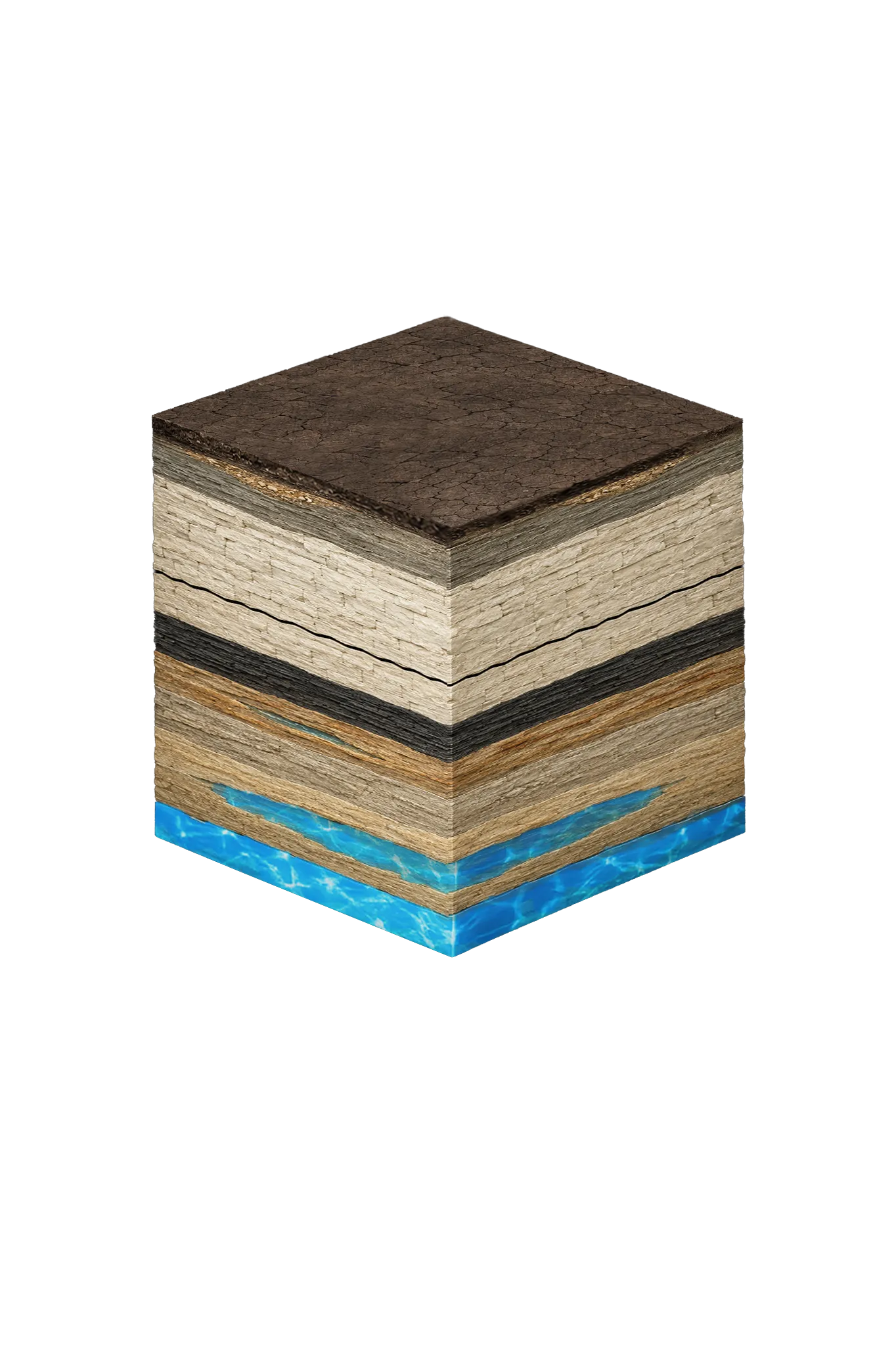
Dallas County’s groundwater is different from the counties to the west, and it’s commonly misunderstood. The Trinity Aquifer is the primary aquifer, but beneath Dallas County it is deep, confined, and far downdip from where it recharges. It is not the shallow, easy-to-reach Trinity that homeowners drill into in Parker or Wise County.
| Formation | Depth in Dallas County | Role |
|---|---|---|
| Quaternary alluvium / terrace | 0–30 ft | Shallow, seasonal, surface-contamination risk; not a dependable residential aquifer |
| Austin Chalk / Eagle Ford | Surface and near-surface (eastern county) | Confining units; not dependable residential aquifers |
| Woodbine Group | ~600–1,500 ft | Minor aquifer where developed; buried this deep in Dallas County, not at 200–400 ft |
| Washita / Fredericksburg | Below Woodbine | Confining section between Woodbine and Trinity |
| Trinity Group (Paluxy, Glen Rose, Twin Mountains) | ~2,000–3,500+ ft | Deep, confined primary aquifer; documented TWDB Dallas County wells at 2,568 ft and 3,076 ft |
The regional rock layers dip deeper from west to east at roughly 60 to 90 feet per mile. Western and southern Dallas County (the Cedar Hill, Grand Prairie, and Duncanville area) is the most plausible setting for a private well because the column of rock above usable water is thinner there. Eastern Dallas County (Mesquite, Garland, Rowlett) is the worst area for private wells because that column is thickest.
There is no single typical well depth for Dallas County. Where private wells exist, they fall into two very different categories: shallower Woodbine wells in the western and southern fringe, and deep confined Trinity wells that are typically 2,000 feet or more and usually drilled for municipal, industrial, or large-estate use rather than an ordinary home. Because the two cases are so far apart, a site-specific driller review and nearby well-log analysis are essential before any depth or cost is assumed.
Why Dallas County Trinity Water Doesn’t Refill Quickly
The Trinity Aquifer recharges where it reaches the surface, roughly 50 to 70 miles west of Dallas in Parker and Wise counties. Beneath Dallas County, the Trinity is downdip-confined paleo-water that moves very slowly. Dallas County Trinity wells do not refill from local rainfall in any practical timeframe. The system has documented long-term water-level declines, so a deep Trinity well here is drawing from a finite, slowly-moving regional resource — not a quickly-replenished local one.
Where Your Water Actually Comes From
For almost everyone in Dallas County, the water at the tap is treated surface water from lakes, not groundwater from a well. The City of Dallas runs entirely on surface water, drawing from six reservoirs — Lake Ray Hubbard, Lewisville, Grapevine, Ray Roberts, Tawakoni, and Fork — and uses no well water at all. On the east side of the county, cities like Garland and Mesquite get their water from the North Texas Municipal Water District, which is also surface water. A private well here is the exception, not the rule — which is part of why dependable local well data is thin and why depth, yield, and cost have to be worked out tract by tract.
Water Quality You Should Expect
Deep Trinity water in Dallas County is often high in total dissolved solids — frequently above 1,000 mg/L, and a documented south-central Dallas County sample measured 2,038 mg/L TDS, with elevated chloride, sodium, and sulfate. Woodbine water can be high in iron in its upper zone, often needs filtration, and water deeper than about 1,500 feet tends to exceed secondary drinking-water standards. Trinity and Woodbine groundwater is typically hard. Whatever the source, test for the common constituents and plan for treatment before relying on the well.
After drilling, test for coliform bacteria, nitrates, total dissolved solids, hardness, iron, and pH. Test before purchasing any treatment equipment.